How roulette actually works
Roulette isn't one of the games you can play here — our arcade runs to bingo, blackjack and dice — but it's the game people ask about most, so here's the honest mechanics of the wheel, maths included. This page is educational only. There is no roulette play, no real money and no promotion of gambling on Southern Spin List.
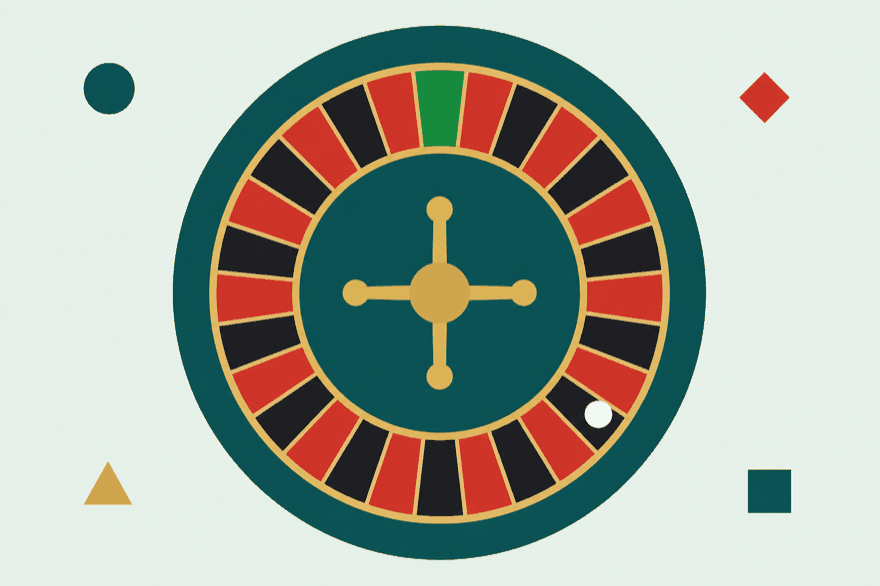
37 pockets, one green outsider
A European wheel has 37 pockets: the numbers 1 to 36, half red and half black, plus a single green zero. Classic table returns are calculated as if that zero did not exist — and its existence is what creates the built-in margin on a real casino floor.
The numbers aren't arranged in order around the rim. They're deliberately scattered so that neighbouring pockets mix high with low and red with black, which stops any section of the wheel looking obviously “hotter” than another.
Inside the number grid: fewer numbers, longer ratios
Selections on the numbered grid itself follow one neat formula — covering n numbers returns (36 − n) ÷ n to 1 on a classic table — and the probability is always n out of 37. The figures below are for understanding the layout, not for play on this site:
| Layout option | Covers | Classic return | Probability |
|---|---|---|---|
| Straight up | 1 number | 35 to 1 | 1/37 ≈ 2.7% |
| Split | 2 adjacent numbers | 17 to 1 | 2/37 ≈ 5.4% |
| Street | 3 numbers in a row | 11 to 1 | 3/37 ≈ 8.1% |
| Corner | 4 numbers in a square | 8 to 1 | 4/37 ≈ 10.8% |
| Six line | 6 numbers, two rows | 5 to 1 | 6/37 ≈ 16.2% |
Around the edge: shorter ratios, bigger coverage
Selections around the grid's edge cover whole categories. Red or black, odd or even, and high (19–36) or low (1–18) each succeed on 18 of the 37 pockets on a classic table — about 48.6%, not the neat 50% the symmetry suggests. The green zero is the missing share. Dozens (1–12, 13–24, 25–36) and columns each cover twelve numbers and return 2 to 1 on a classic table, succeeding 12 times in 37, or about 32.4%.
Where the built-in margin lives
Take a straight-up selection. A mathematically even return on a 1-in-37 shot would be 36 to 1; a classic table returns 35. That one-unit shortfall works out to 1/37 of every unit placed — about 2.7% — and the same arithmetic applies across the single-zero layout. American wheels add a second green pocket (00), which raises the margin to about 5.26% while keeping the same printed returns. That difference is why single-zero and double-zero wheels are not the same thing mathematically.
Two things follow from that. First, no “system” — doubling after misses, waiting for streaks, tracking “sleeping” numbers — changes the arithmetic, because every spin is independent and every layout option carries the same built-in margin. Second, over a long sequence that margin compounds in one direction only. That's not cynicism; it's just the formula above, applied repeatedly.
If you'd like casino-style games without any money involved at all, that's precisely what our free games are for — virtual coins aren't money, so nothing here can be cashed out, purchased or redeemed.