True stories from classic games
Everything below is genuine and checkable — no invented statistics, no legends dressed up as history. Where a story is traditional rather than documented, we say so.
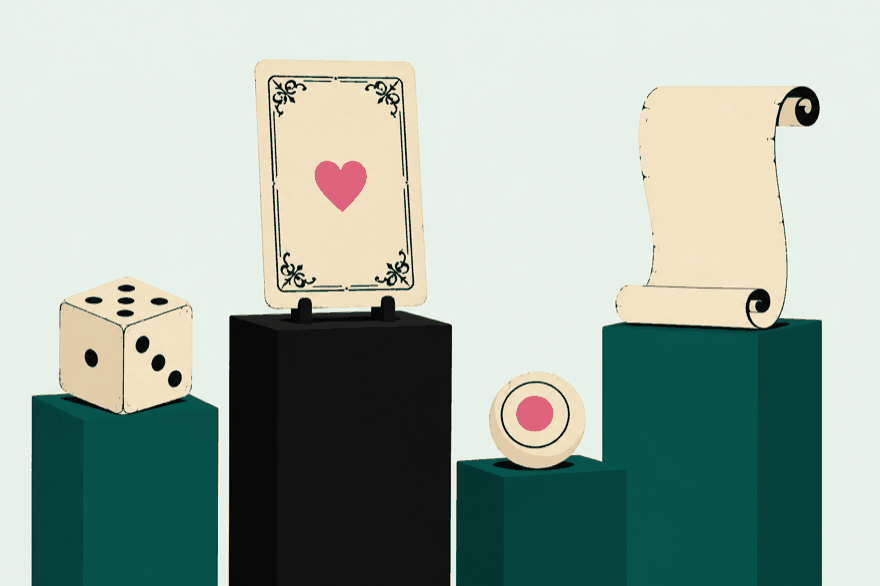
Older than most empires
Dice are among the oldest gaming equipment humans have made. Cube dice recognisably like modern ones have been excavated at Bronze Age sites thousands of years old, and the ancient world also gamed with astragali — the knucklebones of sheep and goats.
Pick up any standard die and check: opposite faces always add to seven. One pairs with six, two with five, three with four. It's been the convention for a very long time, and it makes a loaded or misprinted die easy to spot.
Cards crossed the whole of Asia to reach a poker table
Playing cards are generally traced to China, with clear European records appearing in the 1370s — several cities passed ordinances about card games almost as soon as the cards arrived, which tells you how quickly they caught on. The hearts, diamonds, clubs and spades we use today are the French suit system from the fifteenth century; the simple, single-colour shapes were cheap to stencil, which helped them outcompete fancier German and Latin suits.
Here's the one that bends the mind: a shuffled 52-card deck can be arranged in 52 factorial ways — a number with 68 digits. Shuffle properly, and the order in your hands has almost certainly never existed before in the history of card playing, and never will again.
Bingo was nearly called beano
Bingo's ancestor is Italy's national lottery, Il Gioco del Lotto d'Italia, which has run since the sixteenth century. The version with cards and called numbers spread through Europe, and by the 1920s an American carnival version was played with dried beans as markers — hence "beano". New York toy salesman Edwin S. Lowe popularised it around 1929, and by the traditional account, renamed it after an excited player shouted "bingo!" instead of "beano". Documented or not, the name stuck everywhere.
Blackjack answers to a French name
The game descends from vingt-et-un — "twenty-one" — played in France in the eighteenth century. The English name is widely traced to early American gambling houses, which promoted the game with a bonus for a hand containing the ace of spades and a black jack. The bonus faded; the name didn't. The dealer's fixed rule — draw to 16, stand on 17 — isn't tradition for its own sake, it's what makes the game mathematically analysable at all.
The devil's wheel, by simple addition
Add every number on a roulette wheel, zero through 36, and you get exactly 666 — which is why roulette has carried the nickname "the devil's game" for well over a century. The wheel itself is a French invention (roulette simply means "little wheel"), and the single-zero version most of the world knows was introduced by the Blanc brothers in 1840s Germany. There's more on how the wheel is laid out in our roulette guide — educational only; roulette is not playable on this site.
And one about randomness itself
Every game on this site draws its randomness from your browser's cryptographic random number generator — the same class of tool that secures online banking. It has no memory, no mood and no schedule. That's not a limitation; it's the only version of "fair" that mathematics recognises. Our three games are built on it.